Aim and Scope
The Journal of Sustainable Construction Materials and Project Management (JSCMPM) acts as a leading international platform for advancing knowledge and innovation in the sustainable use of construction materials and the effective management of construction projects. It aims to promote evidence-based solutions to urgent challenges in resource efficiency, environmental stewardship, climate resilience, and equitable development in the built environment. By encouraging interdisciplinary research and practice, the journal supports the University’s research agenda and contributes to the UN SDGs: SDG 9 (Industry, Innovation, and Infrastructure), SDG 11 (Sustainable Cities and Communities), SDG 12 (Responsible Consumption and Production), and SDG 13 (Climate Action). Through rigorous academic exchange and knowledge sharing, the journal seeks to advance sustainable development in the built environment and related fields.
JSCMPM welcomes original research articles, technical notes, review papers, and case studies that present novel insights, systematic analyses, and practical applications in the following key areas of interest, including, but not limited to:
Sustainable and Alternative Construction Materials: Research on recycled aggregates, quarry dust, fly ash, calcined earthen resources, industrial by-products, innovative admixtures, and composite materials that reduce environmental impact and improve construction efficiency; including life-cycle assessment, durability studies, and circular economy practices.
Project Management: Advances in construction productivity, resource optimization, quality and safety management, sustainable procurement, risk and contract management, logistics, digital transformation (e.g., BIM, digital twins), and waste minimization in project delivery, and other related areas such as Project Planning, System Design and Engineering, Project Scheduling and Resource Management, Monitoring, Evaluation, and Performance Optimization, Environmental and Safety Compliance.
Transportation Engineering: Studies addressing sustainable transportation infrastructure, encompassing innovative pavement and roadway materials, traffic flow analysis and modeling, smart and green mobility solutions, safety and logistics management, and other strategies that enhance efficiency, resilience, and environmental sustainability of transportation networks, particularly in developing and climate-vulnerable regions, in alignment with the SDGs.
Infrastructure Systems and Applications: Sustainable approaches for roads, bridges, railways, ports, harbors, airports, and other critical infrastructure, integrating new materials and methods to improve resilience, climate adaptation, and low-carbon development.
Policy, Economics, and Education for Sustainability: Insights on regulatory frameworks, financing models, incentives, educational initiatives, and capacity-building strategies that promote the adoption of sustainable materials and project management practices in the construction industry.
By providing a platform for rigorous research and knowledge exchange across academia, industry, and government, JSCMPM supports evidence-based innovations that advance the construction and transportation sector’s contribution to sustainable development.
JSCMPM Template and Manuscript Submission Guidelines
Under the Information section on the right, please follow the submission guidelines carefully. Manuscripts must be prepared in the IMRAD format and submitted as Microsoft Word (.docx) files, not as PDFs. Please download the JSCMPM Template from the link: https://docs.google.com/document/d/1l87nG1cH6OySMRln-68DhnkC-LbUx0_Q/export?format=docx
Ensure that the Abstract does not exceed 250 words, while all tables and figures are fully editable and not inserted as images. In addition, authors are required to provide their ORCID ID, which uniquely identifies researchers and facilitates the attribution of their scholarly contributions across publications, datasets, and institutional affiliations.
Plagiarism and AI Content Screening Policy
All work submitted to the Journal of Sustainable Construction Materials and Project Management (JSCMPM) will be checked for plagiarism using Turnitin or a similar tool. Manuscripts must meet the JSCMPM standard of not more than fifteen percent (≤15%) similarity, not including reference lists, properly cited quotations, or common academic or procedural phrases. If it exceeds this limit or contains copied content, it will be returned to the authors for editing or may be rejected by the Editorial Team.
The JSCMPM has strict rules governing the proper use of Artificial Intelligence (AI) tools, including AI text-editing or translation apps and image-generation tools. Authors must:
• Clearly state if they used AI tools while making the paper, like in the Acknowledgments section or a specific part called Use of AI Tools, naming the tool and what it was used for.
• Be responsible for all information, like text and pictures that could have been helped or made by AI tools, and ensure all is accurate, truthful, original, and correctly cited.
• Make sure the AI tools used do not cause copying, false data, or fake pictures. If AI misuse that breaks the rules or harms research honesty is found, it will be treated as academic misconduct and handled in accordance with the Journal's or SCIPEDIA’s ethical guidelines.
• Papers that violate the Journal's rules on copying or AI use may be refused or retracted, and the Editorial Board might take other actions.
Publication Frequency
The Journal of Sustainable Construction Materials and Project Management (JSCMPM) is published biannually (twice a year), with issues released in:
• June (First Issue)
• December (Second Issue)
Special issues may be organized on emerging themes and collaborative research projects with academic and industry partners.
Copyright and Licensing
The corresponding author must submit a duly signed Author Declaration and Publishing Agreement, affirming that the manuscript is original, has not been previously published or concurrently submitted elsewhere, and that all listed co-authors have reviewed and approved the submission. Please download the Author Declaration Form from the link: https://docs.google.com/document/d/10YfsAVymN0vE_SIJ-pA-_d9X5JXONIKu/export?format=docx
Authors retain full copyright to their published work. The Journal of Sustainable Construction Materials and Project Management (JSCMPM) is granted the right of first publication, after which the article is distributed under the Journal’s open-access license:
Creative Commons Attribution–NonCommercial–ShareAlike 4.0 International (CC BY-NC-SA 4.0)
https://creativecommons.org/licenses/by-nc-sa/4.0/
This license allows others to copy, distribute, display, perform, and adapt the work for non-commercial purposes, provided that:
• Proper attribution is given to the original authors and to JSCMPM as the original publisher; and
• Any adapted or derivative works are distributed under the same CC BY-NC-SA 4.0 license.
All articles published in JSCMPM are freely and immediately accessible to the public upon publication. The JSCMPM currently does not charge any submission fees or article processing charges (APCs). If the JSCMPM introduces any future costs, this page will be updated in advance with a clear description of the types and amounts of the fees and the exact stage at which they are applied.
Publisher and Hosting Information
Published by Cagayan State University, Carig Campus. The Journal of Sustainable Construction Materials and Project Management (JSCMPM) is hosted and disseminated online via the SCIPEDIA publishing platform, ensuring broad, open access and global scholarly reach.
Indexing and Abstracting Status
The Journal of Sustainable Construction Materials and Project Management (JSCMPM) currently assigns Zenodo-registered Digital Object Identifiers (DOIs) to ensure long-term preservation, discoverability, and stable archival access. These outputs are already indexed in OpenAIRE and Google Scholar, providing persistent visibility and reliable citation tracking. As part of its development roadmap, JSCMPM plans to transition to Crossref-issued DOIs, either through a future upgrade of its SCIPEDIA hosting plan or through institutional Crossref membership under Cagayan State University.
In parallel, JSCMPM is proactively pursuing inclusion in additional reputable indexing and abstracting services such as DOAJ, Semantic Scholar, OpenAlex, ROAD, and BASE to further expand the global reach, discoverability, and accessibility of its published works. Aligned with its long-term strategic vision, the JSCMPM is also progressively positioning itself to meet the standards required for coverage in leading international databases, particularly Scopus and the Web of Science (WoS).
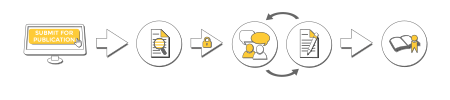
Peer Review Process
The Journal of Sustainable Construction Materials and Project Management (JSCMPM) employs a strict double-blind peer-review process to ensure that all published articles are scientifically sound, new, and valuable. The average time from when a paper is sent out to when an editor makes a decision is 8 to 16 weeks.
(1) First Screening by the Editor-in-Chief
All new papers first go to the Editor-in-Chief and/or Section Editors. Here, the paper is checked for:
• If it fits the goals of JSCMPM; If it meets the journal template and style; And if ethical issues or some documents are missing.
Papers that fail these checks may be returned to the authors or rejected without external review.
(2) Plagiarism and AI Use Check
All papers are checked for text similarity using plagiarism-detection software before being sent to external reviewers. The journal also looks for improper or hidden use of AI tools as outlined in the Plagiarism and AI Screening Policy. Papers with high similarity or serious ethical concerns may be rejected at this stage.
(3) Assigned to Peer Reviewers
Papers that pass the first check are sent to two or more qualified peer reviewers with expertise in the paper's subject. This peer review is double-blind, meaning:
• Reviewers do not know who the authors are, and Authors do not know who the reviewers are.
(4) Review Questions
Reviewers are asked to check the paper for, but not limited to:
• Its originality and new information or ideas;
• Its technical and methodical soundness;
• How clearly it states its goals, methods, findings, and answers;
• Its relevance to sustainable construction materials, project management, and related fields.
• Its quality in figures, tables, and sources;
• Its overall clarity, structure, and ease of reading.
(5) Making a Decision
Based on the reviews and advice, the Editor-in-Chief and/or Section Editors will choose one of:
• To accept with no changes; To accept with minor modifications; To ask the author to make significant changes and send it back; To decline the paper.
The final decision and the anonymous reviewer comments will be provided to the corresponding author.
(6) Fixing and Sending Back the Paper
Authors who have been asked to fix their paper need to send:
• The fixed paper, and a list that responds point-for-point to what the reviewers and editors indicated.
Revised papers may be returned to the same reviewers or forwarded to the Editor-in-Chief for further review, particularly if significant changes are requested.
(7) Getting the Paper Accepted and Published
Once accepted, the paper undergoes editing, layout, and proofreading. Authors can check the page proofs for minor fixes before the paper is published online.
(8) Privacy and Ethical Rules
All papers and reviews are kept private. Reviewers must disclose any conflicts of interest and adhere to ethical guidelines, such as those of the Committee on Publication Ethics (COPE). The editors promise that decisions will be fair, transparent, and based solely on the quality of the work.
SCIPEDIA and Institutional Stewardship
Maintained and supervised by Cagayan State University, Carig Campus, in partnership with SCIPEDIA, the Journal of Sustainable Construction Materials and Project Management (JSCMPM) upholds rigorous standards of quality and ethical publishing. This stewardship ensures academic integrity, alignment with international publishing protocols, and the open-access dissemination of high-quality, impactful research.
Note to Readers
For optimal readability and full appreciation of the figures, tables, and text layout in this article, we strongly recommend downloading and viewing the PDF in double-column format. The double-column PDF layout provides clearer font scaling and a more organized academic presentation than the single-column PDF view.
-------------------------
Office Address
JSCMPM Editorial Team Main Office Address:
Cagayan State University, Carig Campus
RDE Office, Administration Building, Carig Campus, Tuguegarao City 3500, Philippines
E-mail: RDE@csucarig.edu.ph || emer.quezon@csucarig.edu.ph || fsdumlao@gmail.com
Telephone number: 0783952782 Loc 044
Principal Contact
Emer T. Quezon, Ph.D, MSc.CE, M. ASCE
Editor-in-Chief
Campus Director for Research, Development & Extension
Professor (Associate) of Graduate School & College of Engineering & Architecture, Carig Campus, Cagayan State University, 3500 Tuguegarao City, Philippines.
E-mail: emer.quezon@csucarig.edu.ph || quezonet09@gmail.com
Phone: +639451631743
Journal Consultants and Technical Advisers
Arthur G. Ibanez, Ph.D, ASEAN Engr.
JSCMPM consultant & Technical Adviser
University Professor, OIC-University President, Cagayan State University, 3500 Tuguegarao City, Philippines.
E-mail: arthur_ibanez20@csu.edu.ph
Junel B. Guzman, Ph.D
JSCMPM consultant & University Technical Adviser
Vice President for Research, Development, and Extension, Cagayan State University, 3500 Tuguegarao City, Philippines.
E-mail: vprdeoffice@csu.edu.ph
Florentina S. Dumlao, Ph.D
JSCMPM consultant & University Technical Adviser, Cagayan State University, 3500 Tuguegarao City, Philippines.
E-mail: florentinadumlao@csucarig.edu.ph || fsdumlao@gmail.com
Prof. Roger P. Rumpon
JSCMPM consultant & Technical Adviser
Campus Executive Officer, Carig Campus, Cagayan State University, 3500 Tuguegarao City, Philippines.
E-mail: rumpon.roger@csu.edu.ph
Belen Garcia de Pablos, MSc, PhD
SciPedia & JSCMPM consultant, Technology Universidad Politecnica de Madrid
Madrid, Spain
KSS Rakesh, Ph.D
JSCMPM consultant & Technical Adviser
Professor, International Institute of Cambodia University of Technology, Phnom Penh, Cambodia
E-mail: kssrakesh@iic.edu.kh
Editorial Board Members and Peer Reviewers
(1) JSCMPM Editorial Board Members and Peer Reviewers (Local Members)
John Michael B. Casibang, MSc.CE, MST
University Dean & College Dean of Engineering and Architecture
Professor (Associate), Graduate School & College of Engineering & Architecture, Carig Campus, Cagayan State University, 3500 Tuguegarao City, Philippines.
E-mail: jmcasibang@csu.edu.ph
Anderson G. Gonzales, Ph.D
University Director for Research
Professor (Associate), Graduate School & College of Engineering & Architecture, Carig Campus, Cagayan State University, 3500 Tuguegarao City, Philippines.
E-mail: gonzalesanderson@csu.edu.ph
Professor (Associate), Civil Engineering Department, Mapua Malayan Colleges Mindanao, Davao City, Philippines.
E-mail: ecagon@mcm.edu.ph
Joseph B. Cabalbag, M.Eng
Head, Civil Engineering Department
Professor (Associate), College of Engineering & Architecture, Carig Campus, Cagayan State University, 3500 Tuguegarao City, Philippines.
E-mail: jcabalbag@csu.edu.ph
Professor (Assistant), College of Engineering, Technological University of the Philippines (TUP), Ermita, Manila, Philippines.
E-mail: bobby_lupango@tup.edu.ph
Jowell John B. Talosig, M.Eng
Professor (Assistant), College of Engineering & Architecture, Carig Campus, Cagayan State University, 3500 Tuguegarao City, Philippines.
E-mail: engr.jowelljohn@gmail.com
Frances Lorane T. Calapini, MSc.CE, PhD-Cand.
Professor (Assistant) of Graduate School & College of Engineering & Architecture, Carig Campus, Cagayan State University, 3500 Tuguegarao City, Philippines.
E-mail: frances_calapini@dlsu.edu.ph
Ralph Angelo B. Estiller, MCRSDM
Professor (Assistant), College of Engineering & Architecture, Carig Campus, Cagayan State University, 3500 Tuguegarao City, Philippines.
E-mail: ralphangeloestiller@csucarig.edu.ph
Cyrus Kelly Macabangon, MSc
Professor (Assistant), College of Engineering & Architecture, Carig Campus, Cagayan State University, 3500 Tuguegarao City, Philippines.
E-mail: cyrusmacabangon@csucarig.edu.ph
(2) JSCMPM Editorial Board Members and Peer Reviewers (International)
Leevesh Kumar, Ph.D
Professor (Associate), Department of Civil Engineering, World University of Bangladesh, Dhaka, Bangladesh
E-mail: leevesh.kumar@civil.wub.edu.bd
Alemayehu Gebissa Guta, Dr. Ing
Professor, University of Rostock, Rostock, Germany
E-mail: alemayehu.gebissa@uni-rostock.de
Mario Marmolejo, Ph.D
Professor, Civil Engineering Department, Universidad del Quindio, Armenia City, Colombia
Sitesh Kumar Singh, Ph.D
Professor (Assistant), Department of Civil Engineering, National University of Science and Technology, Muscat, Oman
E-mail: siteshsingh@nu.edu.om
Professor (Associate), Head, Construction Quality & Technology Center of Excellence, Addis Ababa Science & Technology University, Ethiopia
E-mail: tesfaye.alemu@aastu.edu.et
Abdin Bedada, Ph.D
Professor (Assistant), Dean, School of Civil & Environmental Engineering, Hachalu Hundessa Campus, Ambo University, Ambo, Oromia, Region, Ethiopia
E-mail: abdin.bedada@ambou.edu.et
Biruk Tadele, Ph.D
Professor (Assistant), Department of Civil Engineering, Haramaya Institute of Technology, Haramaya University, Haramaya, Ethiopia
E-mail: biruk.tadele@aastu.edu.et
(3) Journal Curator and Web Layout Artist (Technical / Production)
Karl Louis S. Quezon, MSIT
Campus Records Officer, Carig Campus, Cagayan State University, 3500 Tuguegarao City, Philippines
E-mail: karllouie.quezon@csucarig.edu.ph
 Evaluation of conventional behavior of bitumen containing PET plastic and HMA pavement response utilizing 3D-Move analysis software
 82
82 15651
15651


 Editorial board
 Impact factor