Affiliation:
(1,2,3,4) Cagayan State University, Carig Campus, College of Engineering and Architecture, Civil Engineering Department, Tuguegarao City, Philippines
ORCID:4*
Licensed under:

1. Introduction
1.1 Background
Designing buildings with thoughtful, efficient structural and architectural plans ensured the safety of individuals who used them and the resilience of the structures in the face of natural disasters. In addition to interrupting daily routines and resulting in loss of life, most natural disasters leave visible signs of devastation (Pijet-Migon & Migon, 2018). These disasters can have a substantial impact on the government's finances and may slow the country's productivity. During natural disasters, school buildings are among the structures that are affected. The quality and safety of educational infrastructure were vital concerns for governments and international organizations. Outdated designs are often the reason why disasters destroy many schools. Educational institutions worldwide are expected to provide secure and well-equipped environments for students and teachers. Enhancing the human aspect of school design involved considering how the school's physical layout affected both learning and well-being. This was particularly important given the substantial time both teachers and students spent at school each week (Manca et al., 2020).
Situated within both the Pacific Ring of Fire and the typhoon belt, the Philippines ranked among the world's most vulnerable nations to natural hazards (Luchi et al., 2019). The interconnection highlighted the intricate geological and meteorological dynamics in the area, where the simultaneous occurrence of typhoons and volcanic activity presented challenges for disaster management and resilience initiatives (Chia & Ropelewski, 2002). It was possible to observe the raw power of our planet Earth as it demonstrated its strength through sudden, sometimes intense events such as volcanic eruptions, earthquakes, and tsunamis (Hinga, 2015). This concern extended to the Philippines, where the Department of Education (DepEd) played a fundamental role in regulating and improving school building standards. Designers needed to acknowledge that these disasters were inherent to natural events and must be taken into account in their planning and decision-making. In 2021, DepEd released an updated set of specifications in its DepEd Order No. 6, s. 2021, which aimed to ensure that schools adhered to the highest standards of safety, functionality, and design. In the Philippines, schools functioned as evacuation centers during natural disasters. For many years, schools in the Philippines, as well as in the broader regions of the Pacific and Indian subcontinent, had been conventionally designated as authorized evacuation sites by government authorities. They also served as informal shelters and critical hubs for distributing aid, where essential supplies are transported, organized, and provided to those requiring assistance (Asia Pacific Coalition for School Safety, 2017).
The compliance of school buildings with DepEd Order No. 6, s. 2021 was a critical factor in the overall enhancement of the Philippine education system. Since educational institutions played a significant role in shaping both the present and future generations, the construction of school buildings should have been given paramount importance (Umali, 2021). The quality of educational infrastructure directly impacts the learning experiences of millions of students and the effectiveness of teaching. A safer, stronger school could protect children's lives, serve as a safe haven for the local community during emergencies, and aid in restoring normalcy after a disaster (Ayala et al., 2020). Recognizing that the construction of these structures must prioritize resilience against severe weather conditions, seismic activity, and extreme storms, while also taking into account classroom capacity, size, and student spacing requirements. Assessing nationwide compliance was crucial for making informed policy decisions and addressing disparities in educational infrastructure across regions and communities in the Philippines. Local stakeholders, including school administrators, parents, and students, were deeply invested in the quality of their educational facilities. Local assessments of compliance also served as a basis for dialogue and engagement, enabling community members to actively participate in shaping their children's education. Conducting this study to assess the compliance of school buildings with DepEd Order No. 6, 2021 was essential; this not only demonstrated a dedication to providing high-quality education and secure learning environments on a global scale but also stood as an essential mandate both nationally and worldwide.
1.2 Statement of the Problem
In education infrastructures, regulatory compliance is Critical. This is to ensure that the safety and quality of school environments are key to providing students with secure and nurturing settings. However, many educational institutions struggle to consistently meet these regulatory standards due to resource constraints, oversight gaps, or a lack of awareness and enforcement. When schools fail to comply with regulatory requirements, student safety and learning quality may be put at risk. This situation highlights the importance of evaluating how well schools comply with official guidelines and what factors influence such adherence. Consequently, this paper aims to analyze regulatory compliance levels in educational settings, identify gaps in adherence, and propose corrective actions to ensure schools operate in accordance with mandated standards, thereby creating safer and more effective learning conditions.
1.3 Objectives
The general objective of this study was to evaluate the level of compliance of public-school buildings with DepEd Order No. 6, s. 2021.
Specifically, it aimed to:
- 1. Conduct an assessment of school physical facilities using a structured assessment tool and evaluate their level of compliance with DepEd Order No. 6, s. 2021.
- 2. Evaluate the level of awareness of the school's physical facility coordinator and the school head on the DepEd Order No. 6, s. 2021.
- 3. Determine the relationship between the awareness of school physical facility coordinators and school heads and the compliance level of school buildings with DepEd Order No. 6, s. 2021.
- 4. Identify areas of improvement for enhancing the compliance of school buildings with DepEd Order No. 6, s. 2021.
1.4 Conceptual Framework
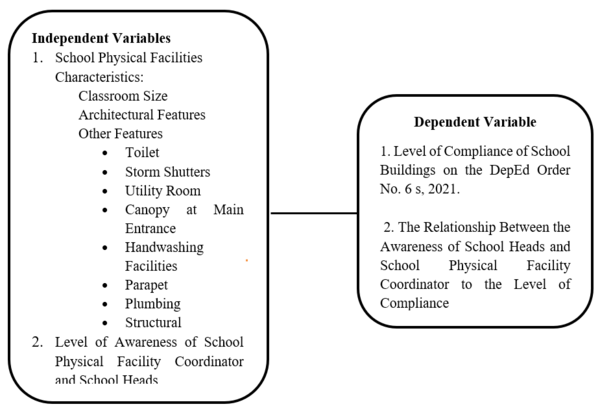
In this study, the independent variables encompass various characteristics of school physical facilities, including classroom size, architectural features, other features, plumbing, and structural aspects. These factors are key influences on the overall level of compliance of school buildings with the established standards outlined in DepEd Order No. 6, S. 2021. In addition, the level of awareness among school physical facility coordinators and school heads is another independent variable, given the pivotal role awareness plays in adherence to regulatory guidelines. In Figure 1, the dependent variable in this research indicates the level of compliance of school buildings, reflecting the extent to which these facilities align with the specified standards and regulations. By examining the relationships between these variables, the study aims to provide insights into the factors influencing the compliance of school buildings with established guidelines.
1.5 Significance
The study is of immense significance, as it serves as a vital tool for informed decision-making and policy formulation. It provides a basis for formulating policies related to school infrastructure and safety standards. Assessing the extent to which school buildings comply with the Department of Education's guidelines provides a comprehensive understanding of the infrastructure challenges faced by educational institutions in Tuguegarao City. This, in turn, enables local authorities to develop targeted policies and allocate resources more effectively to enhance the quality of education and safety within the city's schools, ultimately benefiting both students and educators.
2. Methodology
In an era of rapid educational development, the safety and suitability of school infrastructure are paramount concerns. DepEd Order No. 6, s. The 2021 framework served as a critical tool for ensuring that school buildings meet essential standards. This research project is dedicated to assessing the level of compliance of public schools in Tuguegarao City with the requirements outlined in this directive. By comprehensively evaluating compliance levels, this study aimed to provide valuable insights and data to inform evidence-based policy formulation. In doing so, it contributes to the ongoing efforts to create safe and conducive learning environments, ultimately enhancing the quality of education within the Philippines.
2.1 Study Area
The research focuses on Tuguegarao City, located in the southern part of Cagayan province and the capital of Cagayan, Philippines. The city comprises 18 public elementary schools distributed across four distinct districts: Tuguegarao North, Tuguegarao Northeast, Tuguegarao East, and Tuguegarao West. In addition to these elementary schools, there are six high schools and seven integrated schools, all of which are part of the DepEd institution within the city's boundaries. These educational facilities were evaluated to assess their compliance with the specified DepEd Order.
2.2 Research Design
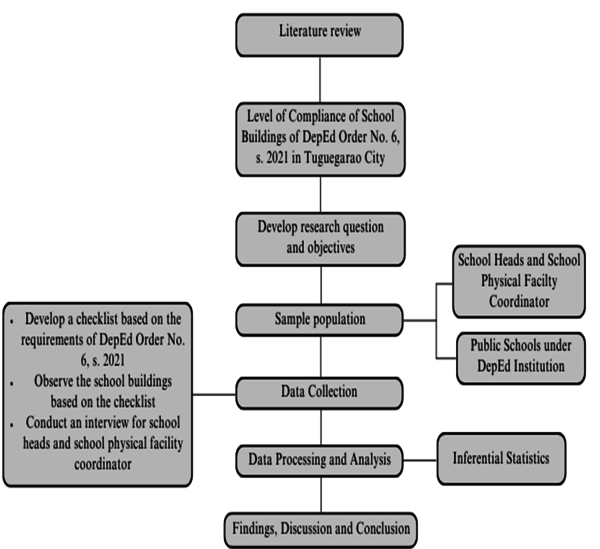
This research design focuses on conducting a comprehensive assessment of compliance with DepEd Order No. 6, s. 2021, within the educational infrastructure of Tuguegarao City, Philippines. This study aims to identify schools across the city for a rigorous evaluation of their adherence to the order's standards and guidelines. Additionally, the level of awareness of the school's physical facility coordinator and school head regarding DepEd Order No. 6, S. 2021, will be evaluated, and their relationship with each other will be determined using a descriptive correlational analysis via Spearman's correlation. Data will be collected through school visits, interviews, and observation using a structured assessment tool. The analysis will encompass inferential analysis to quantify compliance levels in the school buildings. The ultimate objective is to provide insights that can serve as the foundation for policy formulation, driving improvements in school building quality and enhancing educational outcomes within Tuguegarao City.
2.3 Data Collection
2.3.1 Number of Schools Data
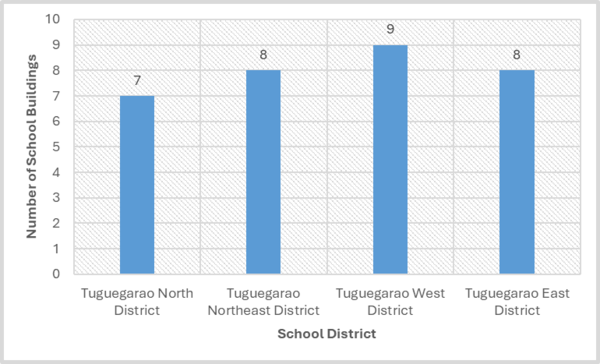
The study focuses on public elementary, junior, and senior high schools in a specific area, aiming to provide a comprehensive understanding of the city's educational landscape. This inclusive approach encompasses both types of schools to provide a holistic representation, ensuring a thorough assessment of compliance with educational standards outlined in the DepEd Order. It contributes to a more comprehensive analysis of the educational infrastructure within the area by considering various school locations and promoting a nuanced evaluation. Moreover, the city comprises 18 public elementary schools spread across distinctive districts: Tuguegarao North District, Tuguegarao Northeast District, Tuguegarao East District, and Tuguegarao West District. In addition to these elementary schools, there are six public high schools and seven integrated schools within the city's boundaries, all under the DepEd's purview.
2.3.2 Level of Compliance Data
This involved a well-structured method for gathering information to determine how effectively an organization or system is following established rules and standards. It is achieved by systematically collecting data through observation questionnaires anchored to DepEd Order No. 6, s. In 2021, assess how well the organization is adhering to the guidelines it is supposed to follow. The data collected provides a numerical measure of compliance, offering insights into how closely the rules are being followed. This data is extremely valuable as it helps decision-makers identify areas for improvement, ensuring the organization better aligns with required standards and regulations. This process is essential for maintaining accountability and improving the quality of organizations and systems.
2.4 Research Instrument
In this study, a qualitative research methodology was employed. A checklist designed and validated in accordance with the DepEd Order No. 6, s. 2021 was utilized to assess the School Buildings' Compliance Level. The checklist encompasses various aspects of the school's physical characteristics, including architectural features, classroom size, plumbing, electrical systems, toilets, storm shutters, utility rooms, handwashing facilities, a canopy at the main entrance, and parapets. Furthermore, a structured interview comprising a closed-ended questionnaire was administered to school heads and physical coordinators to gauge their level of awareness regarding the DepEd Order.
3. Results and Discussion
3.1 Profile of School Buildings
3.1.1 Type of Buildings/Structures based on funding
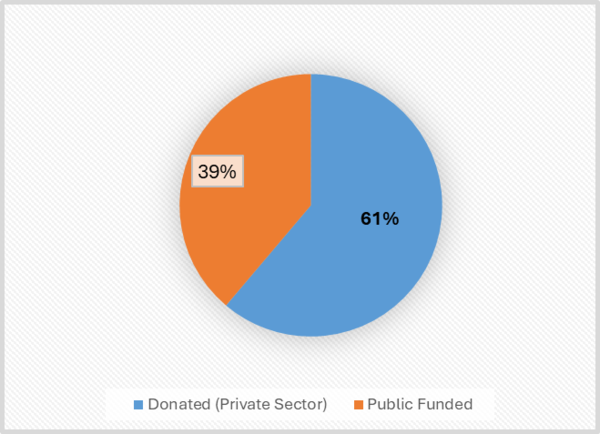
Figure 4 presents the frequency distribution of school buildings in the DepEd division of Tuguegarao City, classified by funding source. The collected data indicate that there are 152 academic institutions within the study area, of which the private sector donates 93 buildings (61%), while the government funds 59 buildings (39%). Classifying buildings into two types based on their funding sources — public government-funded or private sector-funded — aims to assess the compliance level for each funding source and evaluate how well each sector adheres to the regulatory standards and specifications outlined in the DepEd order. The dominance of privately donated school buildings in Tuguegarao's DepEd division underscores the private sector's significant role in enhancing the quality of education. Meanwhile, government-funded buildings demonstrate the public sector's ongoing efforts to provide essential infrastructure. This collaborative effort between the private and public sectors helps provide sufficient facilities and resources for both students and educators.
3.1.2 Year of Completion
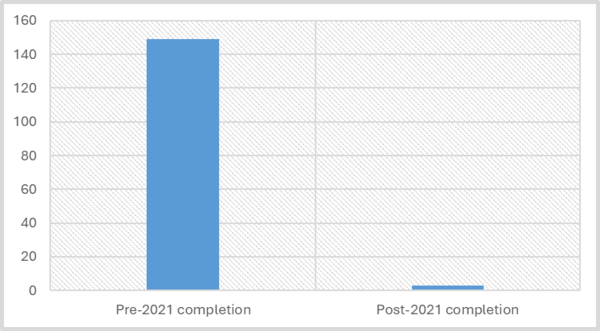
Figure 5 indicates that among the 152 school buildings examined, the majority (149, 98%) were completed before 2021. In contrast, only a small percentage of 3 buildings (2%) were finished after 2021. The data were categorized by year of completion, as this study primarily assessed the compliance of school buildings with DepEd Order No. 6, issued in 2021. These buildings were separated into pre-2021 and post-2021 completions to facilitate analysis. The significant difference in completion years highlights the need for continuous monitoring and evaluation of school construction projects to ensure compliance with current standards. Additionally, it emphasizes the importance of implementing updated guidelines for improving the quality and safety of educational facilities for students and staff.
3.1.3 Number of floors of buildings
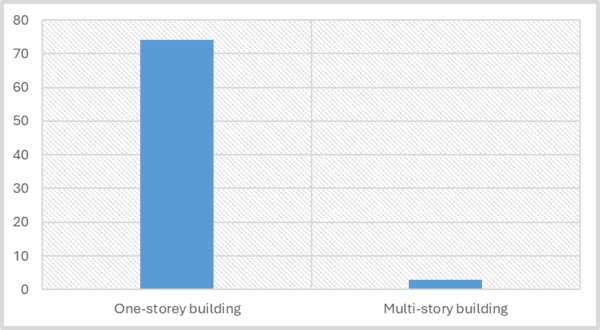
Figure 6 presents the total 152 school buildings evaluated; 74 (49%) were classified as one-storey buildings, while 78 (51%) were categorized as multi-storey buildings. The majority of school buildings are constructed as multi-storey structures to accommodate a larger number of students, especially in urban areas. In addition, Guaralda and Mayere (2023) stated thatare due to limited land availabilityr due to land availability being limited. However, the structured observational tool utilized in this study, adapted from the DepEd order, incorporates criteria specific to multi-storey buildings. Hence, it was necessary to distinguish between multi-storey and single-storey structures to ensure precise data collection.
3.2 Level of Compliance
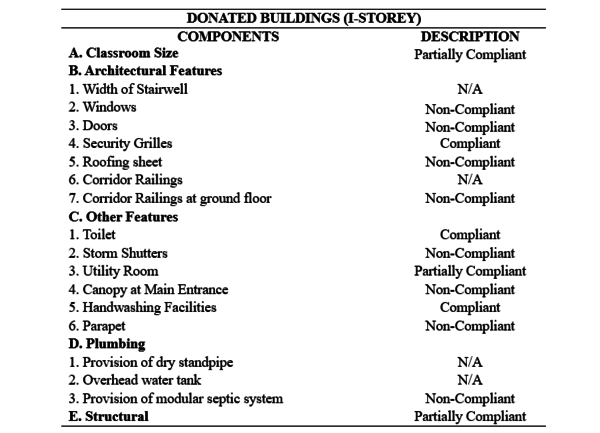
3.2.1 Donated School Buildings 1-Storey
Table 1 shows the result for the level of compliance of donated 1-storey school buildings with the DepEd Order. The assessment revealed that the school buildings varied in their compliance with the directive. When it comes to the size of the classrooms, the weighted mean of 2.20 was calculated, which indicates partial compliance. This suggests that while the classrooms are adequately sized, there is fully meet the proposed standardst the proposed standafor architectural features such as windows, doors, roofing sheets, and corridor railings, weighted means of 1, 1.18, 1.09, and 1.27, respectively, were9, and 1.27, respectively, was identified. This indicates that these elements fall short of meeting the proposed design standards and need modifications. However, the security grilles with a weighted mean of 2.51 are compliant with the set standards. Storm shutters, the canopy at the main entrance, and the parapet, with their corresponding weighted averages of 1.09, 1.36, and 1.04, signify non-compliance of the school buildings. Additionally, the provision of a modular septic system gained a weighted mean of 1, indicating non-compliance with the standard. Las, with a weighted mean of 1.93, indicat weighted mean of 1.93 signifies partial compliance of the school buildings with the DepEd Order. Overall, the weighted mean of 1.54 suggests a general trend towards non-compliance with the proposed design standards. This highlights the need to address deficiencies in various aspects of the donated one-storey school buildings, ensuring they meet the desired standards for a conducive learning environment. Furthermore, the range of means provided allows for a comprehensive understanding of the compliance levels, categorizing them into non-compliance, partial compliance, and compliance based on the weighted mean score.
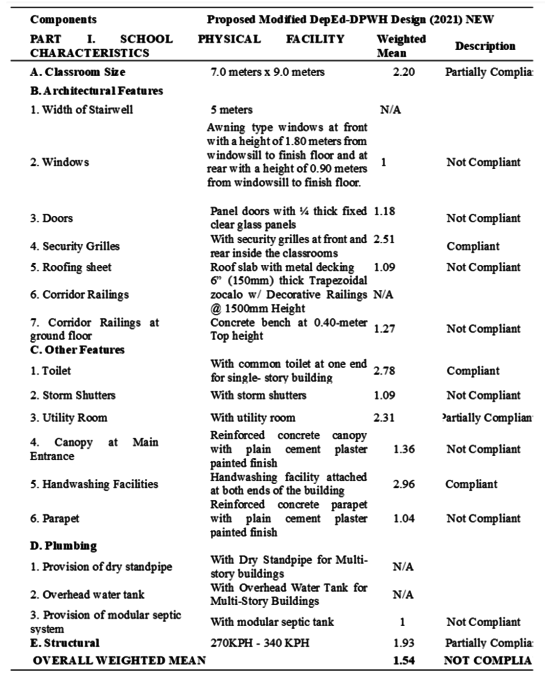
Range of Means: Non- Non-Compliance 1-1.67; Partially Compliance 1.68-2.34; Compliance 2.35-3
3.2.2 Donated School Buildings Multi-Storey
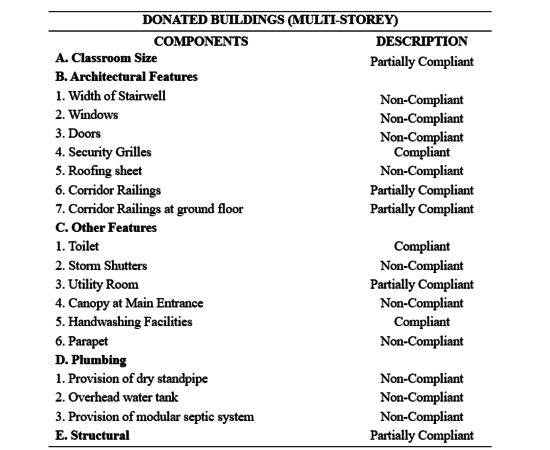
Table 2 presents an assessment of the compliance level of donated one-storey school buildings with the DepEd Order. It indicates that the features shown have a differing level of compliance with the directive. The weighted mean fclassroom size was 2.28, indicating partial complianceant. While the classrooms were found to be adequately sized, there is still potentito fully adhere to the proposed standardslly. Regardiarchitectural features such as stairwell width, windows, doors, roofing sheeting, and security grilles, it was identified that these elements fall short of meeting the proposed design standards and requireeed modifications. The weighted means for these features were 1.4, 1.04, 1.32, 1.11, 1.64, and 1.19, respectively. However, the corridor railings were partially compliant and required minor improvemrds, as indicated by their weighted mean of 1.64. Security grilles were found to be compliant with the set standards, with a weighted mean of 2.68. Other features, such as storm shutters, a canopy at the main entrance, and a parapet, were marked as non-compliant and requiring significant enhancements. Their corresponding weighted averages were 1.06, 1.34, and 1.28, respectively. Additionally, the utility room was partially compliant, with a weighted mean of 2.21, while the toilet and handwashing facilities complied with tspecific design standardign. Lastly, the provision of dry standpipe, overhead water tank, and modular septic system was marked as non-compliant, with corresponding weighted means of 1.04, 1.43, and 1. They did not meet the required standard. The structural feature was determined to comply with the DepEd Order, achieving a weighted mean of 2.49. This indicates that the buildings' structural aspects meet the standards specified in the DepEd Order, ensuring their safety and integrity.
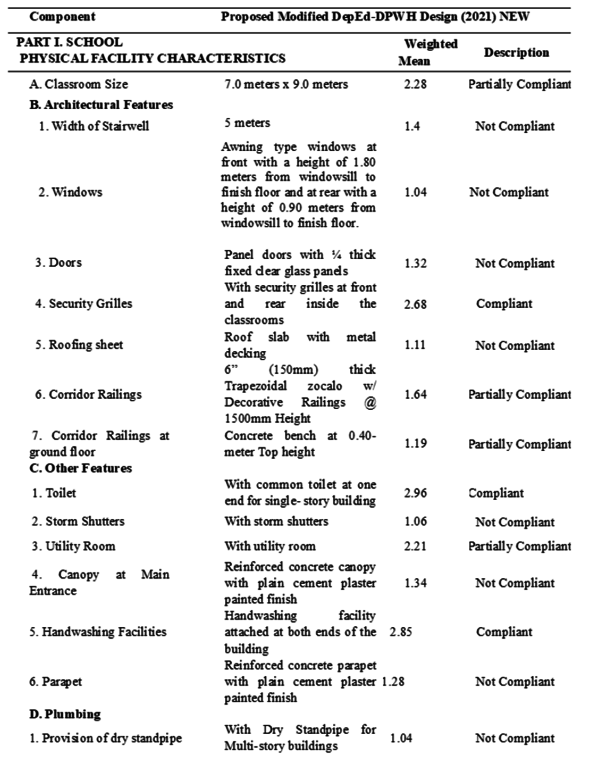
Range of Means: Non-Compliance 1-1.67; Partially Compliance 1.68-2.34; Compliance 2.35-3
3.2.3 DepEd School Buildings Pre 2021 1-Storey
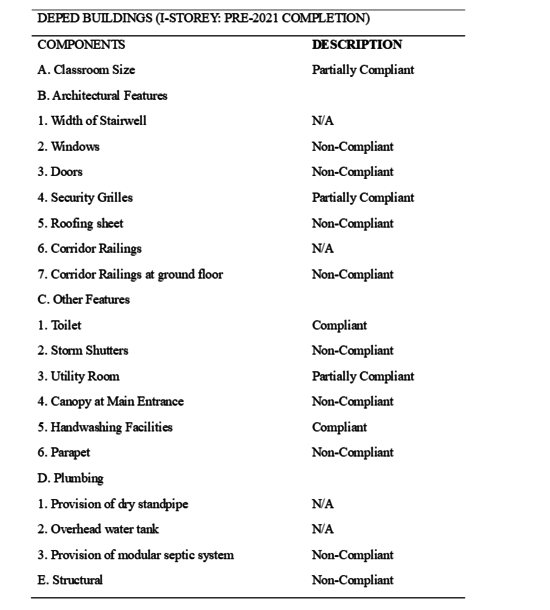
Table 3 illustrates the diverse levels of compliance of various features assessed in schools based on the DepEd order. The classroom size, with a weighted mean of 2.27, indicates partial compliance, suggesting the need for minor enhancements. Conversely, architectural features such as windows, doors, roofing sheets, and corridor railings at the ground floor exhibit non-compliance, as indicated by their corresponding weighted means of 1.07, 1.17, 1, and 1.03, respectively, falling short of the required standard specifications. Security grilles, with a weighted mean of 2.57, indicate partial compliance and require minor enhancements in line with the directive. Regarding other features, toilet and handwashing facilities achieve full compliance, with weighted means of 2.93 and 2.77, respectively. However, utility rooms show partial compliance, with a weighted mean of 2.33, indicating the need for minor enhancements. Storm shutters and the canopy at the main entrance demonstrate lower levels of compliance, with weighted means of 1 and 1.6, respectively, suggesting the necessity for significant enhancements in these areas. In terms of plumbing, the modular septic tank is non-compliant, with a weighted mean of 1, indicating a deviation from DepEd order standards. Lastly, the structural element, with a weighted mean of 1.08, highlights the need for significant enhancements and indicates non-compliance with the DepEd standards.
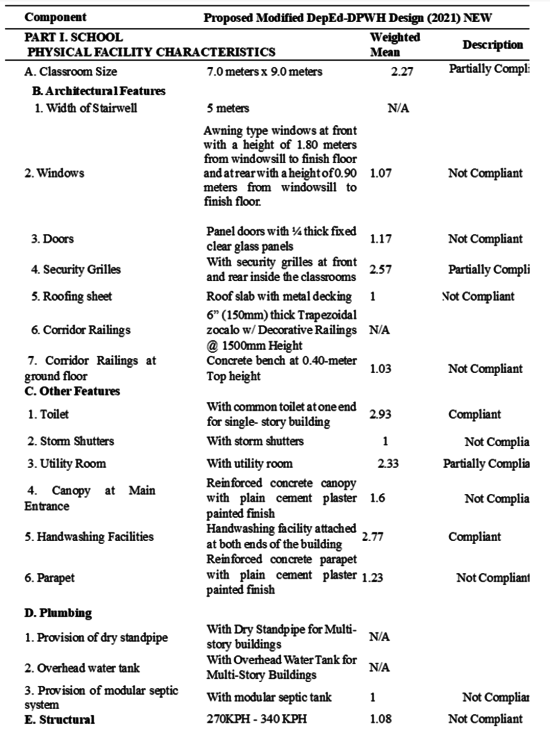
Range of Means: Non- Compliance 1-1.67; Partially Compliance 1.68-2.34; Compliance 2.35-3
3.2.4 DepEd School Buildings Pre 2021 Multi-Storey
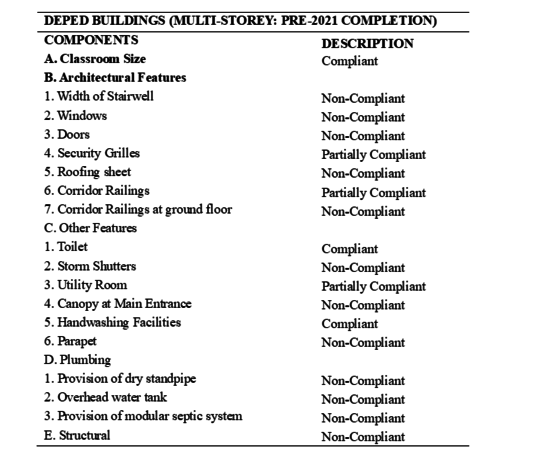
Table 4 presents the level of compliance of pre-2021 school buildings with the DepEd Order. The assessment revealed that the school buildings exhibit varying levels of non-compliance with the directive. The majority of the multi-storey classroom buildings met the standard for classroom size and security grilles, with a weighted mean of 2.47 and 2.59, indicating full compliance. However, architectural features such as the width of stairwells, windows, doors, roofing sheets, and corridor railings on the ground floor fell short of the proposed design standards, with weighted means of 1.81, 1, 1.28, 1.06, and 1.41, respectively. The corridor railings partially complied with the set standards, with a weighted mean of 2.03. Storm shutters, the canopy at the main entrance, and the parapet, with their corresponding weighted averages of 1.13, 1.19, and 1.28, signify non-compliance of the school buildings. Additionally, the provision of dry standpipe, overhead water tank, and modular septic system had weighted means of 1.13, 1.14, and 1, respectively, indicating non-compliance with the standard. Lastly, the structural compliance with a weighted mean of 2.44 suggested partial compliance of the school buildings with the DepEd Order. In summary, the weighted mean of 1.83 indicates a general trend towards partial compliance with the proposed design standards. This highlights the need to address deficiencies across various aspects of DepEd multi-storey school buildings to ensure they meet the desired standards for a conducive learning environment. The range of means offered allows for a comprehensive understanding of the compliance levels, categorizing them into non-compliance, partial compliance, and compliance based on the weighted mean Score.
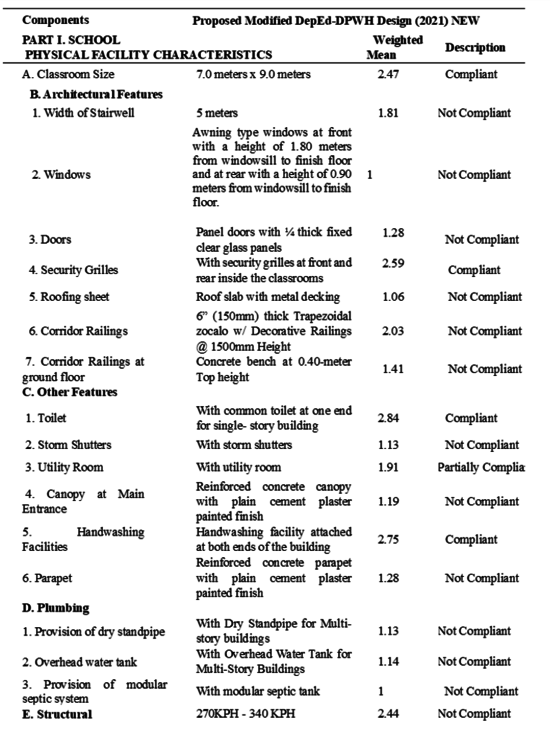
Range of Means: Non- Compliance 1-1.67; Partially Compliance 1.68-2.34; Compliance 2.35-3
3.2.5 DepEd School Buildings Post 2021 1-Storey
Table 5 presents the level of compliance of post-2021 school buildings with the DepEd Order. The assessment revealed that the school buildings have varying levels of compliance with the diThe mective. Majority of the 1-storey classroom buildings met the standard for classroom size with a weighted mean of 2.5, indicating full compliance. Conversely, architectural features such as windows, roofing sheets, and corridor railings at the ground floor exhibit non-compliance, as indicated by their corresponding weigh, all of which fall, falling short of the required standard specifications. Security grilles, with a weighted meindicate partial compliance and require minor enhancements in line with based on the directive. In addition, the door has a weighted mean of 2.5, indicating full compliance. Other features, such as the toilet, utility room, and handwashing facilities, were marked as compliant and met the standards. Their weighted averages are 3. Additionally, the storm shutters and parapet are non-compliant and require a significant enhancement, with a corresponding weighted mean of 1. In contrast, the canopy at the main entrance is partially compliant and only needs a minor enhancement. Lastly, the provision of a modular septic syfound non-compliant,compliant with a weighted mean of 1. They didn't meet the required standard. The structural feature was detercomplyompliance with the DepEd Order, achieving a weighted mean of 3. This indicates that the structural aspects of the buildings meet the specified standards outlined in the DepEd Order, ensuring their safety and integrity.
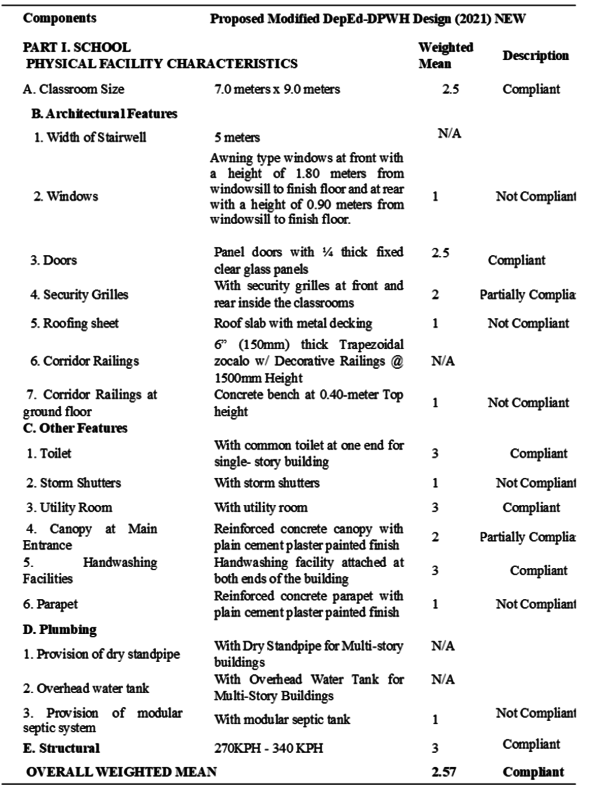
Range of Means: Non- Compliance 1-1.67; Partially Compliance 1.68-2.34; Compliance 2.35-3
3.3 Level of Awareness of School Facilities Coordinator on DepED Order No. 6
3.3.1 School facility coordinator
The table presents the responses of school physical facility coordinators to a questionnaire on their awareness of DepEd Order No. 6, s. 2021. The majority of participants expressed "Strongly Agree" across various aspects of the order's guidelines. The weighted mean of 2.90 indicates that the participants demonstrated high awareness of the specific guidelines outlined in the order. The respondents strongly agree with a weighted mean of 2.80 on the effectiveness of current school building designs in meeting the prescribed requirements. The weighted mean of 2.70 shows that respondents strongly agree on the long-term implementation of the order and the establishment of reporting mechanisms to assess progress and challenges. The respondents also strongly agree, with weighted means of 2.63 and 2.70, respectively, on addressing non-compliance issues and implementing measures to comply with physical facility standards outlined in the order. The respondents show strong agreement, with a weighted mean of 2.83, in seeking external assistance or collaboration with relevant stakeholders to ensure the successful implementation of the guidelines. The respondents consistently demonstrate a high level of awareness, with a weighted mean of 2.53, showing a strong agreement that they conduct regular surveys or feedback sessions to gauge stakeholder satisfaction. Notably, the participants strongly agree, with a weighted mean of 2.97, that inspections should be undertaken to ensure that upgraded school building designs align with safety and accessibility standards. Overall, the questionnaire responses' weighted mean of 2.74 indicates a collective "Strongly Agree" sentiment among participants.
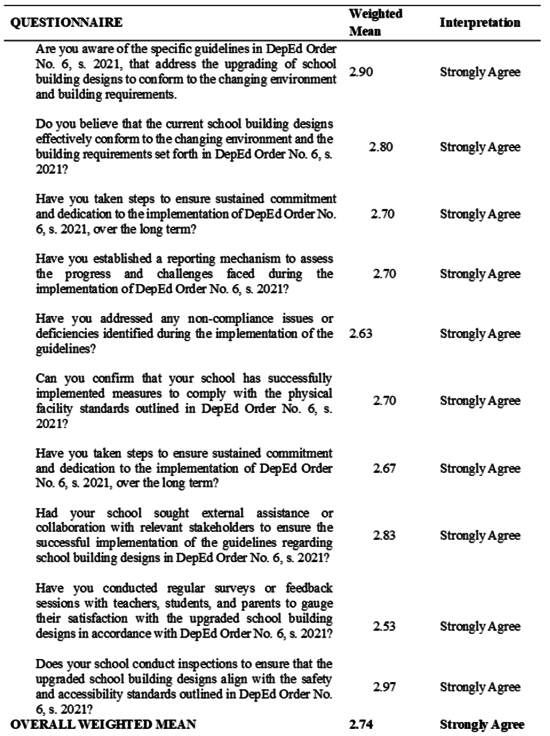
Range of means: Disagree 1-1.67; Neutral 1.67-2.34; Strongly Agree 2.34-3
3.4 Specific Areas for Improvement
3.4.1 Donated School Buildings (1-Storey)
Table 7 presents the specific areas in need of improvement within both donated and single-storey school buildings, aligning with the standard school characteristics outlined in DepEd Order No. 6 s. of 2021. Among the factors/results obtained from observations on the data regarding compliance level, they highlight various aspects such as windows, doors, roofing sheets, ground-floor corridor railings, storm shutters, canopy at the main entrance, parapet, and the provision of modular septic tanks, all of which necessitate significant improvements. Additionally, it identifies classroom dimensions, utility rooms, and structural integrity as requirenhancnor improvements. Moreover, various elements, such as security grilles, restroom facilities, and handwashing facilities, are fully compliant with the standards outlined in the mentioned DepEd order. The data collected from those donated school buildings indicates that many of the elements identified as non-compliant are attributed to the fact that these donated buildings adhere to their own set of building specifications. This is because the DepEd Order was only released and approved in 2021. It is essential to address these factors holistically to improve safety, create a conducive learning environment, and ensure uniformity in school building design.
3.4.2 Donated School Buildings (Multi-Storey)
Table 8 presents the areas in both donated and multi-storey school buildings requiring improvements, in accordance with the specifications laid out in DepEd Order No. 6 of 2021. Minor immodificationare necessary for several key elements, including classroom size, corridor railings (both on the ground floor and throughout the building), the utility room, and structural aspects. Several factors, such as stairwell width, windows, doors, roofing sheet, storm shutter, main entrance canopy, parapet, provision of dry standpipes, installation of overhead water tanks, and implementation of modular septic systems, necessitate significant improvements. Findings in Table 8 appear similar to those in Table 7, as both involve donated school buildings with various elements requiring sigubstantialmprovements.
3.4.3 DepEd School Buildings (1-Storey: Pre-2021 Completion)
Table 9 presents the areas in both DepEd and single-storey school buildings requiring improvements, in accordance with the specifications laid out in DepEd Order No. 6 of 2021. Several aspects, including windows, doors, roofing sheets, coground-floor corridor railingsstorm shutters, a canopy at the main entrance, paa rapet, and a modular septic tank, require significant improvement. Minor enhancements are evident in thelements such as classroom sizes, security grilles, and utility rooms inhe school buildings. Many elements appear tonon-compliant, given that the DepEd order was issued in 2021nd most of the school buildings in the dataset were constructed before that year. However, there are still areas or elements that fully adhere to other specifications despite this discrepancy.
3.4.4 DepEd School Buildings (Multi-Storey: Pre-2021 Completion)
Table 10 presents the areas in both DepEd and multi-storey school buildings requiring improvements, in accordance with the specifications laid out in DepEd Order No. 6 of 2021. Several aspects, such as the width of the stairwell, windows, doors, roofing sheet, corridor railings on the ground floor, storm shutters, canopy at the main entrance, parapet, provision of a dry standpipe, overhead water tank, provision of a modular septic system, and structural, necessitate significant improvements. Minor enhancements are evident in thelements such as classroom sizes, security grilles, and utility rooms inhe school buildings. Table 4.6 similarly reflects non-compliance with several elements, as the DepEd order was issued in 2021, and most school buildings in the dataset were completed before then.
4. Conclusion and Recommendation
4.1 Conclusions
Based on the results and findings of this study, the proposed modified DepEd-DPWH design is not generally followed, particularly in terms of compliance between donated and non-donated buildings. However, some components range from partial compliance to full compliance, indicating that the schools involved in the study have met the design standards in most areas, although some standards remain unmet. Several reasons, such as insufficient allocated funds to cover all necessary improvements and existing building structures that may not easily accommodate modifications required by the new standards, make compliance more difficult without substantial renovations.
The findings indicate a high level of awareness among school physical facility personnel regarding the implementation of the DepEd order. This indicates that school facility coordinators are well-versed in the DepEd order's guidelines and processes, which is essential for ensuring theirpracticale implementation in the school area.
The relationship between compliance level and awareness level is not significant, despite a high level of awareness about DepEd Order No. 6, s. 2021. There are indeed issues beyond the school heads' and school facility coordinators' control; schools often face financial limitations that hinder their ability to comply with the design standards fully. The approval and disbursement of funds or permissions might be impeded by administrative procedures, leading to considerable delays that can impact the timely implementation of the necessary modifications. The results indicate a significant positive correlation value of 0.3919, or “parapet,” between respondents' compliance and awareness levels for both donated and non-donated buildings constructed before 2021. This implies that as respondents' awareness of the standard design increases, their adherence to it also improves. Therefore, increasing awareness about the standards can lead to better adherence and overall improvement in the quality of school infrastructure.
The number of areas that each group identified as requiring significant improvement to comply with the DepEd standard of school buildings. In some groups, such as donated buildings and non-donated buildings, there are pre-2021 and post-2021 completions of the building structures. It does not prove easy to assess the effectiveness of school upgrades without adequate evaluation processes in place. Gathering feedback from school heads, facility coordinators, and other stakeholders is crucial for identifying areas of concern and improving compliance in school buildings.
4.2 Recommendations
The following are recommendations recorded based on the results obtained in the study:
1. Develop a policy mandating that all future school buildings adhere to the specifications outlined in the DepEd order. This will ensure uniformity and compliance with established standards.
2. Enhance awareness of the DepEd order among school physical facility coordinators by encouraging attendance at seminars related to its implementation. This proactive approach can deepen understanding of the directive.
3. Given the absence of a significant relationship between the level of awareness of school physical facility coordinators and the compliance level of school buildings, future research could consider interviewing other stakeholders involved in school construction, such as designers or construction personnel.
4. Implement regular inspections by school physical facilitators to assess the condition of school facilities and identify areas in need of major and minor improvements. This systematic approach will enable timely interventions to enhance the overall quality and safety of school buildings.
Acknowledgment
The authors would like to acknowledge the Civil Engineering Department faculty for their advice and encouragement during this research undertaking.
Funding
The authors received no direct funding for this research.
Conflict of Interest
The authors declare that there is no conflict of interest.
References
Adaranijo, F. O. (2021). An Assessment of Public School Facilities and Teachers in Obi LGA, Nasarawa State. International Journal of Multidisciplinary Academic Research, 2(3). Retrieved from Al-Hashlamun, H. H. (2019). Building Envelope Thermal Upgrade for School. IOP Conference Series: Earth and Environmental Science.
Alven Lopez, N. E. (2018). Level of Compliance with the Risk Reduction and Disaster Preparedness Program among Public Secondary Schools in Buenavista, Bohol, Philippines. ACADEME University of Bohol, Graduate School and Professional Studies, 12(1).
An Thi Hoai Le, K. S. (2018). Sustainable refurbishment for school buildings: a literature review. International Journal of Building Pathology and Adaptation. Retrieved from Bhandary, Y. R. (2023). A Case Report on Damage to School Buildings During the 2015 Nepal Earthquake and Reconstruction Strategy. Research Square.
Dina D'Ayala A., C. G. (2020). Resilient communities through safer schools. International Journal of Disaster Reduction, 45.
Dr. Fawzi Ali Abdel Rahman AL Zamil, D. D. (2023). Evaluating Compliance with Universal Design. Arab International Journal of Digital Art & Designs.
Glenn Christopher J. Lambino, R. M. (2019). Design and Implementation of the Proposed Four-Storey High School Building in Lyceum of the Philippines-Laguna using Leadership in Energy and Environmental Design LEED). LPU-Laguna Journal of Engineering and Computer Studies, 4(2).
Hinga, B. D. (2015). Ring of Fire. Bloomsbury Publishing.
Llego, M. A. (2014). Upgrading of DepEd School Building Designs to Conform to the Changing Environment and Building Requirements of Schools.
Marcelo Victor Alves Bila Queiroz, R. M. (2019). Dynamic efficiency of primary education in Brazil: Socioeconomic and infrastructure influence on school performance. Socio-Economic Planning Sciences, 70.
Matthews, T., Newton, C., Guaralda, M., & Mayere, S. (2023, January 1). Vertical Schools as Community Hubs. https://doi.org/10.1007/978-981-19-9972-7_15
Pijet-Migoń, P. M. (2019). Natural Disasters, Geotourism, and Geo-interpretation. Geoheritage.
Reem Nassif, E. A. (2019). Multi-criteria assessment for the functional-energy upgrade of the UAE school sector: a bottom-up approach promoting refurbishment versus new construction. Architectural Engineering and Design Management, 167-190.
Sara Manca, V. C. (2020). The Effect of School Design on Users’ Responses: A Systematic Review (2008–2017). Sustainable Education and Approaches, 1(8).
Spearman Rank Correlation (Spearman’s Rho): Definition and How to Calculate it - Statistics How To. (2024). Statistics How To. https://www.statisticshowto.com/probability-and-statistics/correlation-coefficient-formula/spearman-rank-correlation-definition-calculate/
Taglucop, L. (2023). Understanding School Plant Management in Public Secondary Schools and Compliance with DepEd Standards.
Umali, M. V. (2021). Level of compliance by the Bulacan State University with the fire and safety requirements of the law. Global Journal of Engineering and Technology Advances, 17(1).
5, R. S. (2018). A comparative study of the environmental health and safety of urban and rural schools of Abadan and their compliance with national standards. Journal of Advances in Environmental Health Research, 6(1), 9-16. Doi: 10.22102/JAEHR.2017.100597.1043
Document information

Published on 02/11/25
Submitted on 02/11/25
Volume 1, Issue Issue-2, December, 2025
DOI: https://doi.org/10.5281/zenodo.17567379
Licence: Other
Share this document
Keywords

claim authorship
Are you one of the authors of this document?